Italy’s 7% Flat Tax for Retirees: Who Qualifies and Where
Italy’s 7% flat tax sounds almost too good when you first hear about it.
Move to Italy.
Choose the right town.
Pay 7% on foreign income for up to ten years.
For many retirees, that sounds like the kind of rule that could make the whole Italy plan work.
But this is Italy, and tax rules are never just one sentence.
The 7% regime can be very useful for the right person. But it is not for everyone, not every town qualifies, and the tax saving only matters if the place actually works for your life.
I also covered this in my video Italy’s 7% Tax: 7 Towns Where It Actually Works (2026).
So before you start choosing towns from a list, it is worth understanding what the regime is really designed to do.
What is Italy’s 7% flat tax?
Italy’s 7% flat tax is a special tax regime for qualifying retirees who move their tax residence to certain towns in southern Italy.
In simple terms, if you qualify, you may be able to pay a 7% substitute tax on certain foreign-source income, instead of being taxed under Italy’s ordinary progressive income tax system.
You can also use the Italy Tax Calculator to get a basic estimate before making bigger decisions.
The regime can apply for up to ten years.
That is the part that gets people’s attention.
But the important words are:
if you qualify.
This is not a discount Italy gives to anyone who likes old villages, warm weather, and cheap wine.
It is a specific tax regime with specific requirements.
Who is it meant for?

The 7% regime is mainly aimed at people receiving a foreign pension who move their tax residence to eligible municipalities in southern Italy.
That usually means retirees with income from outside Italy, such as:
foreign pensions
Social Security or state pension income
private pensions
investment income
foreign rental income
other foreign-source income, depending on the situation
But the foreign pension is the key part. This is not just a “move to Italy and pay 7%” rule for everyone.
If you are still working, running a business, earning Italian income, or relying mostly on income that does not fit the regime properly, you need proper tax advice before assuming this applies to you.
Where does it apply?
This is where people often get confused.
The regime is connected to specific municipalities in southern Italy, not to the entire country.
The eligible regions are generally:
Sicily
Calabria
Sardinia
Campania
Basilicata
Abruzzo
Molise
Puglia
So no, this is not a tax route for retiring in Florence, Milan, Lake Como, Rome, or most of the famous northern and central places people first dream about.
The whole point of the regime is to encourage people to move to smaller towns in the south and help bring life, money, and long-term residents into those areas.
That is why the town matters as much as the tax rate.
The 2026 change that matters
One of the most important changes reported in 2026 is the expansion of the population threshold from towns under 20,000 residents to towns under 30,000 residents.
That may sound like a small technical change, but it is not.
A town under 20,000 people can be beautiful, but sometimes limited. Fewer services. Less transport. Less healthcare access. Less year-round life.
A town under 30,000 residents can open the door to more practical places.
More shops.
More services.
Better transport.
More medical access.
More chance of actually living there comfortably.
That does not mean every town under 30,000 is a good choice.
It just means the conversation becomes more interesting.
The mistake people make
The biggest mistake is choosing a town because it qualifies for the tax regime.
That is backwards.
A town can qualify on paper and still be wrong for your life.
Before getting excited about the 7% tax, ask:
Can I reach a hospital?
Can I live there without a car?
Is there a train station?
Are there shops open year-round?
What is winter like?
Is there a rental market?
Is there a community?
Will I need fluent Italian for daily life?
Is the town alive, or just beautiful?
This is where fantasy planning becomes dangerous.
Saving money on tax is useful.
Moving somewhere that does not work for your health, lifestyle, or long-term needs is not useful.
It is not only about tax
The 7% regime is only one piece of the retirement puzzle.
If taxes are one of your biggest concerns, the Complete Italy Tax Guide goes deeper into the issues this article only introduces.
You still need to think about:
visa or residency route
healthcare
housing
transport
language
cost of living
tax treaties
foreign assets
estate planning
whether your home country still taxes you
For example, Americans may still have US filing obligations even after moving to Italy. Other nationalities have their own rules. Some pensions may be treated differently depending on treaties and source country rules.
That is why this should not be handled with a quick online calculator or a random Facebook comment.
The 7% regime can be powerful, but only if it fits the full picture.
What kind of towns make sense?
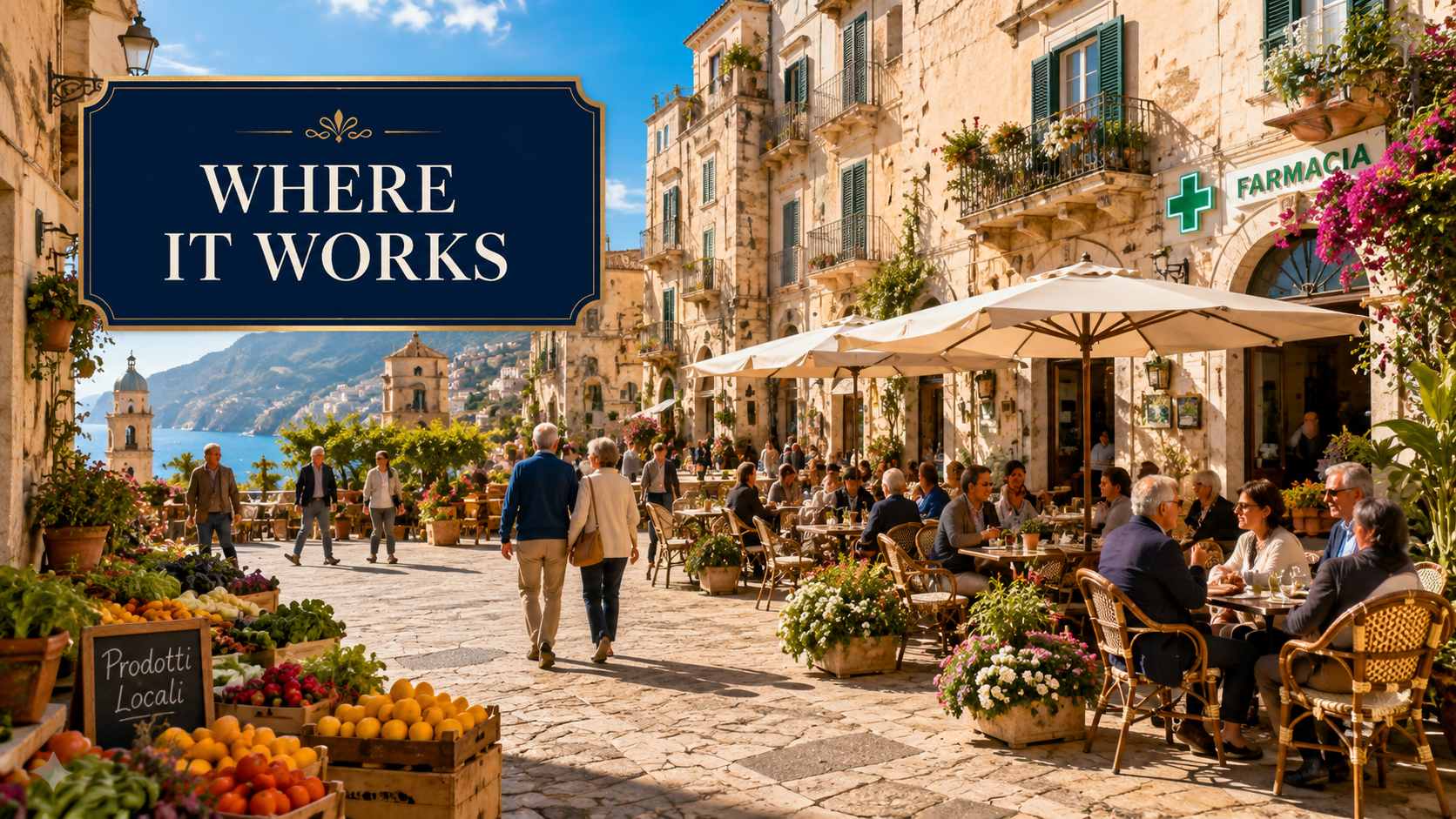
The best towns for this regime are not necessarily the cheapest towns.
They are the towns where the tax benefit and the lifestyle both work.
A good candidate might have:
enough population to support real services
access to healthcare
good regional connections
a livable historic center
reasonable housing costs
year-round activity
access to nature or the sea
a lifestyle you can imagine in January, not only in June
That last point matters.
A town that feels magical on a summer scouting trip may feel very different in winter.
So if you are seriously considering the 7% regime, visit in the off-season if you can.
That is when you see the real place.
Who this regime may work well for
Italy’s 7% flat tax may be worth researching if:
you receive a foreign pension
you are ready to become an Italian tax resident
you want to live in southern Italy
you are open to smaller towns
your income is mostly foreign-source
you want a lower-tax structure for a defined period
you are willing to plan properly before moving
It is especially interesting for people who already like regions such as Abruzzo, Puglia, Calabria, Sicily, Basilicata, Molise, Campania, or Sardinia.
If those regions already appeal to you, the 7% regime may strengthen the case.
If you only want Tuscany or Lake Como, it probably will not help.
Who should be careful
Be careful if:
you are not actually ready to live in Italy full-time
you want to keep your real life mainly in another country
your income situation is complicated
you have large foreign assets
you own foreign property
you are still working
you want a big city lifestyle
you are choosing the town only because of the tax rate
The regime is not a shortcut around proper tax planning.
And it is definitely not a reason to move somewhere unsuitable.

The real question
The question is not:
“Which towns qualify?”
The better question is:
“Which qualifying towns could I actually live in?”
That is a very different search.
A town that works for retirement needs more than charm. It needs enough practical life around it.
Healthcare.
Transport.
Housing.
Community.
Daily services.
Winter rhythm.
A cost structure that makes sense.
The 7% tax is attractive, but the town still has to pass the real-life test.
Final thought
Italy’s 7% flat tax can be a serious opportunity for the right retiree.
But it should not be treated like a magic door into cheap Italy.
It is a planning tool.
Used well, it may help reduce tax pressure and make certain southern towns more realistic.
Used badly, it can lead people to choose places that look good on paper but do not work in real life.
So before you chase the lowest tax rate, ask the harder question:
Could I actually build a good life there?
If you are still at the early planning stage, start with the free Italy relocation roadmap.
That is where the real planning begins.
Want to go deeper?
I made a video on this topic:

In it, I look at seven towns where the regime may make sense not just because of tax eligibility, but because the towns may also offer a more realistic lifestyle.
You can also use the Italy Tax Calculator to get a basic estimate, and if taxes are a major part of your move, the Complete Italy Tax Guide goes deeper into the issues this article only introduces.
This article is for general information only. It is not tax, legal, immigration, or financial advice. Before making decisions, speak with a qualified Italian commercialista or cross-border tax professional.
