Can You Get a Mortgage in Italy as a Foreigner? Here's How It Actually Works
Most people planning a move to Italy assume they're paying cash or they're not buying at all. It's a reasonable assumption — Italian banks are genuinely more cautious with foreign buyers than a US or UK lender would be. But "more cautious" isn't the same as "won't do it." Foreigners can get a mortgage in Italy regardless of citizenship or residency status. The real question isn't whether you qualify — it's how much you'll need to put down and how long it'll take, and both of those depend entirely on one thing: where your income comes from.
The One Number That Decides Everything: Where You're Resident and Paid
Italian banks don't really care whether you're American, British, or Australian. What they care about is risk — and income earned outside Italy, in a currency that isn't the euro, is harder for them to verify and collect against if something goes wrong. That's the entire logic behind everything below.
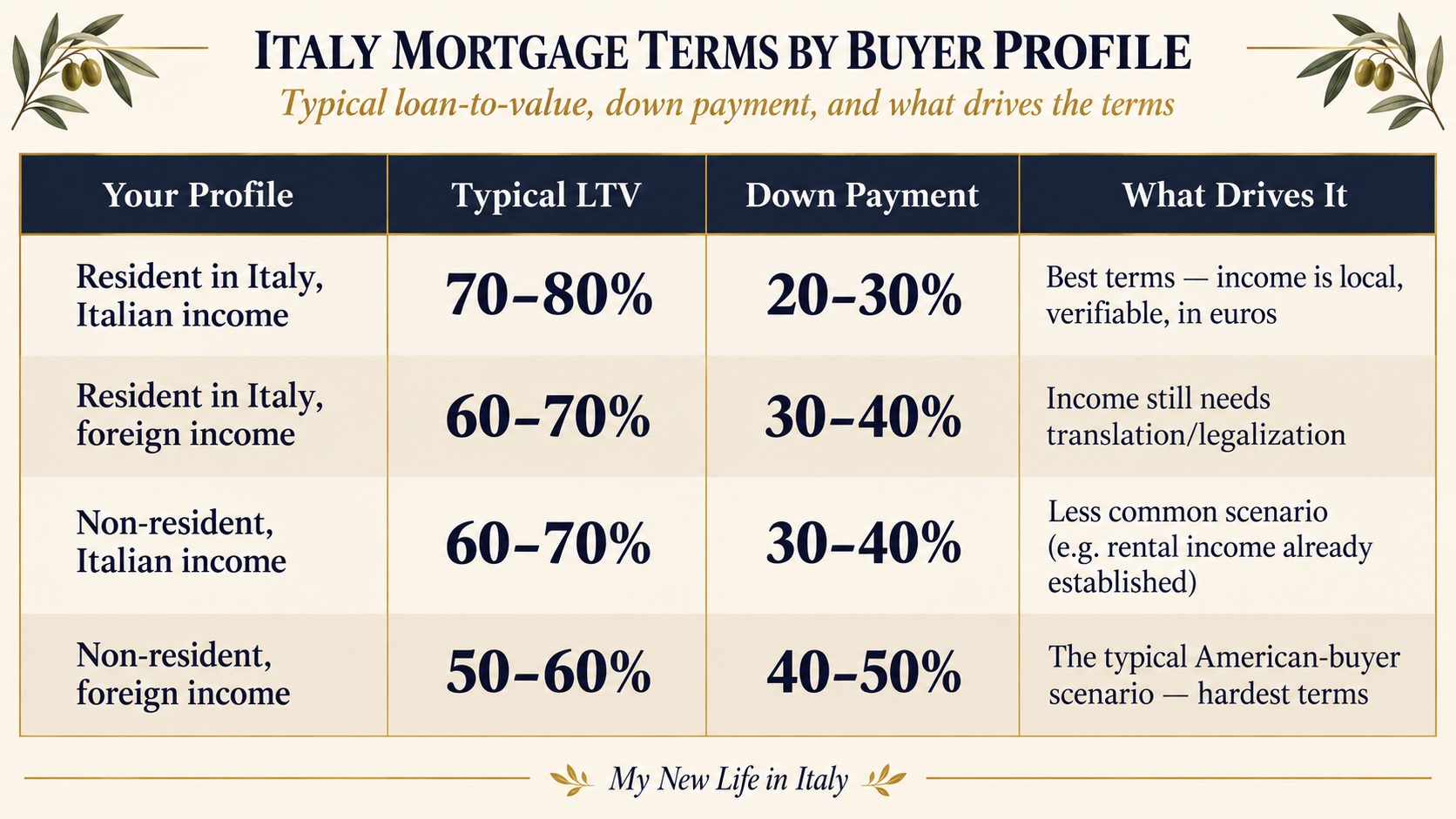
If you're reading this from the US, planning to buy before you relocate, budget for the bottom row: 40–50% down. That's the reality most guides gloss over, and it's the number that should shape your budget from day one, not something you discover three months into the process.
What You'll Actually Need
A codice fiscale first, always. This is Italy's tax ID number, and you cannot open an Italian bank account or start a mortgage application without one. If you haven't gotten yours yet, this is step zero — it's simple to get, but it has to happen before anything else does.
Two to three years of financial paper trail. Tax returns, payslips or pension statements, bank statements showing liquidity, and documentation of any existing debt. Everything issued outside Italy needs to be translated and typically apostilled or legalized — build in time for this, it's a common bottleneck.
Room in your budget beyond the down payment. Banks cap your total monthly debt — the new mortgage payment plus any car loan, existing mortgage, or other obligation — at roughly 30–35% of your net income after tax. They're looking at what you can actually carry, not just what you're asking to borrow.
What It Costs and How Long It Takes
Rates for both fixed and variable mortgages have been running in the 3.0–3.6% range, depending on the term you lock in. Loan terms run shorter for non-residents — typically capped at 20–25 years, versus up to 30 for residents with Italian income — and every mortgage in Italy has to be fully repaid before the borrower turns 75, which is worth factoring in if you're financing later in life.
Timeline-wise, a resident with Italian income can sometimes close in 1–2 months. A non-resident financing with foreign income should realistically expect 3–4 months or more, once translations, legalizations, and the bank's extra risk review are factored in. If you're on a timeline tied to a visa application or a lease running out, build the mortgage process in early — it is not the fast part of buying in Italy.
Where to Go From Here
If you're earlier in the process and still working out whether buying makes financial sense at all, that's what the Italy Retirement Blueprint is built to help you think through.
If you're deep in the renovation side of this already, the full Buying & Renovating a House in Italy page covers what happens after you own the place.
Mortgage interest, property taxes, and ongoing costs all interact with your tax situation once you're in Italy — the Complete Italy Tax Guide covers that side.
And because bank policies and rates shift more often than almost anything else in this process, a consultation call is the fastest way to get numbers specific to your actual situation rather than a general guide.
Frequently Asked Questions
-
Yes. Nationality isn't the deciding factor — residency status and where your income comes from are what actually shape the terms you're offered.
-
Most non-resident buyers paying with foreign (non-euro) income should expect to put down 40–50% of the purchase price. Residents with Italian income can put down as little as 20–30%.
-
Some lenders set a practical floor around €150,000 for foreign-buyer mortgages — below that, financing may not be worth the paperwork compared to just paying cash, depending on the bank.
-
No — non-residents can apply, but the terms are noticeably less favorable than for residents, and the approval process takes longer.
-
A codice fiscale. Nothing else — bank account, mortgage application, property offer — can happen before you have one.