
This is the question I get more than almost any other, and it's usually being asked from the wrong starting point.
People search for "the best visa for Italy" like there's one right answer.
There isn't — there are three genuinely different paths, and which one fits you depends entirely on one thing: whether you plan to work, and if so, for whom.
Here's how the three actually compare.
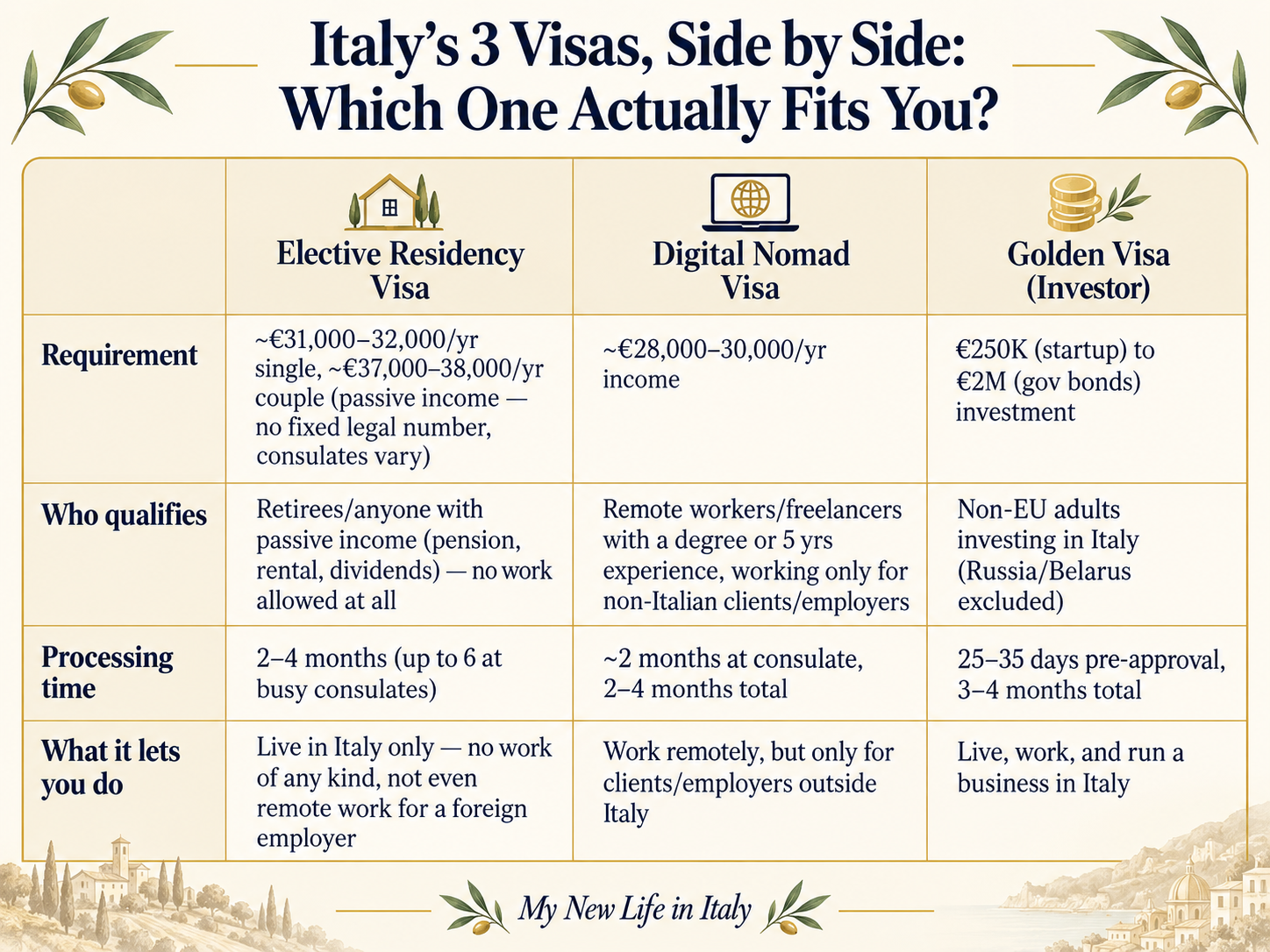
Elective Residency Visa — For People Who Don't Need to Work
This is the visa built for retirees and anyone living on passive income — a pension, rental income, dividends, annuities. The tradeoff is total: it doesn't just block Italian employment, it blocks work of any kind, including remote freelance work for a client back home. If you're planning to keep earning while you live here, this isn't your visa.
There's no fixed income number written into the law — it only requires "ample, stable, and regular means" — which is why consulates set their own bar, and why that bar runs higher in Rome or Milan than in a small town in Calabria. Budget toward the higher end of the range if you're applying through a major-city consulate.
For the full walkthrough — required documents, how consulates evaluate applications, and common rejection reasons — the ERV Guide goes deeper than this page can.
Digital Nomad Visa — For People Who Work, Just Not For Italy
This one exists for people who want to keep their current income while living in Italy. Two categories qualify: self-employed remote workers and employees of a foreign company, both needing either a relevant degree, a 3+ year post-secondary qualification, or five years of work experience, plus six months of documented remote-work history.
The catch is in the name of the game, not the fine print: every client or employer has to be based outside Italy. Pick up Italian clients or take an Italian job while on this visa and you're outside its terms.
Golden Visa — For People Investing Their Way In
This is the only one of the three that lets you actually work inside the Italian economy — employment, self-employment, running a business, all of it. That's the real distinction, and it's exactly why it demands capital instead of just proof of income: four investment routes, from €250,000 into an Italian innovative startup up to €2 million in government bonds.
This path has enough moving parts — the Nulla Osta pre-approval, investment timing, ongoing maintenance requirements — that it deserves its own page. Read the full Golden Visa breakdown here.
Which One Actually Fits You?
Run through this in order:
If you're retired or living on passive income and don't need to earn anything new — the Elective Residency Visa is built for exactly that, and nothing else qualifies you for it.
If you have a job or clients outside Italy and want to keep working while you live here — the Digital Nomad Visa is the only one of the three that allows it, and only under that condition.
If you have capital to invest and want the option to work, start a business, or actively participate in the Italian economy — the Golden Visa is the one path that doesn't restrict that.
If none of these fit cleanly — you're still working out your income situation, your timeline, or whether this move makes sense at all — that's a step before the visa question, not a visa problem. That's what the Italy Retirement Blueprint is built to help you work through first.
FAQ
-
Generally yes, but it's not automatic — switching categories typically means a new application meeting that visa's own requirements, not a simple upgrade. Plan around the visa that fits your situation now rather than assuming an easy path between them.
-
No. The moment your income comes from an Italian client or employer, you're outside the terms of this visa category.
-
No — this is the strictest of the three on this point. The visa requires you to have no employment or self-employment income, foreign or domestic, which is different from the Digital Nomad Visa's foreign-only restriction.
-
Not in the law itself — it requires "ample and stable means," and individual consulates interpret that, which is why real-world figures vary somewhat by where you apply.
-
It's a separate track from things like the 7% flat-tax regime for pensioners — a Golden Visa gets you residency through investment, not a lower tax rate. Some investors do layer it with other tax regimes, but that's a conversation for a tax professional, not a generic answer here.
Where to Go From Here
If the Elective Residency path fits your situation, the ERV Guide walks through the application in full.
If you're still deciding whether any of this is the right move before you get into visa specifics, start with the Italy Retirement Blueprint.
Tax questions almost always follow visa questions — the Complete Italy Tax Guide covers what each of these paths means for what you'll actually owe.
And if you want answers specific to your situation rather than a general guide, a consultation call is the fastest way to get there.
(Note: this page is informational, not legal advice — visa rules and consulate practices change, and an immigration attorney or the Italian consulate serving your area is the final word on your specific case.)