
Moving
to Italy
Most people searching "how do I move to Italy" are really asking two questions. Which visa fits me? And what do I actually do first?
Almost every guide answers the first one and skips the second. This page does both.
It's the map. It won't replace the deep dives on visas, taxes, healthcare and towns. It points you to them at the right moment, in the right order, so you're not guessing which piece to research first.
If you're retiring on a pension or passive income, the Retire in Italy guide goes deeper on that path.
Can You Just Move to Italy?
Not on a tourist stay. With a US, Canadian, UK or Australian passport, you can spend up to 90 days in any 180-day period in Italy without a visa. Staying longer means a long-stay visa, and you apply for it before you leave home.
Two things have changed for short stays. The EU's Entry/Exit System, which replaces passport stamps with biometric registration, has been fully operational at all Schengen borders since April 10, 2026. ETIAS, the pre-travel authorization for visa-exempt visitors, is not in operation yet. As of early October 2026 it has no confirmed start date, so check the official EU travel site before you book.
The Question That Decides Your Path: How Do You Earn Money?
There's no single "move to Italy" visa. There are several routes, and which one fits depends on one thing: where your income comes from, and whether you plan to keep working.
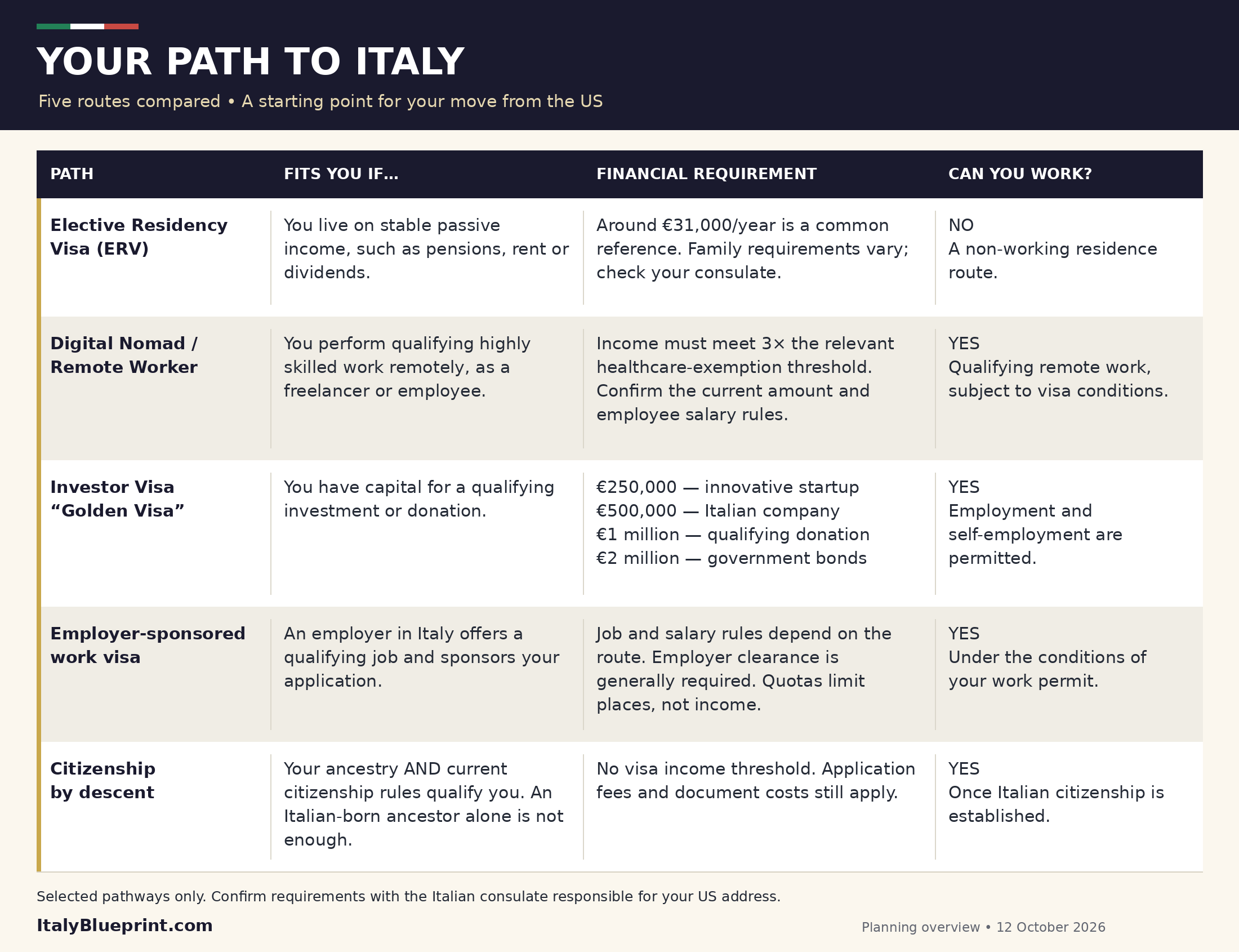
A few notes on that table:
Descent has tightened. Since March 27, 2025, new claims generally succeed only if a parent or grandparent was born in Italy and held only Italian citizenship. A great-grandparent is no longer enough, unless your application was already filed before the cutoff. The rules are still being tested in court, so check current guidance before you spend money on documents.
Work visas run on quotas. Italy has set aside close to 500,000 work visas for non-EU nationals for 2026 to 2028, but they're tied to an employer, so this route only fits you if you already have an offer.
Buying a house does not get you a visa. There's no real-estate route. You can buy without a visa. You just can't live there beyond 90 days in 180 on that alone.
The Italy Visa Types Compared page walks through the three main visas side by side.
The Steps, in Order
This is the part most guides skip. The order matters, because several steps can't start until an earlier one is done.
1. Pick your path. Use the table above. If you're between two, the question to answer is whether you plan to work.
2. Get your codice fiscale first. It's Italy's tax ID, and almost everything else depends on it: bank account, lease, mortgage, healthcare, even parts of visa paperwork. You can get one in Italy, at some consulates, through a delegate, or through an online service. See Codice Fiscale in Italy for all the routes.
3. Arrange private health insurance. For the visa itself you need a private policy before you apply, because you can't use the Italian public system yet. Consulates typically want at least €30,000 of coverage, and they read the dates and the small print. A short travel policy won't do. (Optional: Feather offers expat health insurance built for Italy visa applications: get a quote. I earn a small commission if you sign up, at no extra cost to you.)
4. Secure housing. The ERV generally needs a registered 12-month lease or a property deed before you apply, and the Digital Nomad Visa also requires proof of accommodation. Renting first is usually the safer choice. It lets you live through a winter before you commit to a purchase.
5. Apply at the consulate that covers where you live. Processing times vary: ERV decisions typically take 2 to 4 months, longer at busy consulates, and Digital Nomad Visa applications run roughly 30 to 120 days, with self-employed applicants at the long end. The visa fee is about €116.
6. Within 8 working days of landing, apply for your permesso di soggiorno. You pick up a kit at a post office, send it in, then attend an appointment at the local Questura for fingerprinting. You'll receive a receipt that serves as proof of legal presence while the permit is processed, and then collect the card itself.
7. Enroll in healthcare. Once you're resident, you can join the national health service voluntarily. The contribution is a minimum of €2,000 a year and rises with income. Keep your private policy active until your permesso is issued and your enrollment is complete, so there's no gap in coverage.
8. Sort out your taxes. Once you're a tax resident, Italy taxes your worldwide income. Foreign pensioners who move to an eligible town in one of eight southern regions can qualify for a flat 7% rate on foreign income. The town must have 30,000 residents or fewer (the cap was raised from 20,000 in April 2026), and you must not have been an Italian tax resident in the previous 5 years. Otherwise, ordinary rates apply: 23% up to €28,000, 33% up to €50,000, and 43% above that. US citizens still file US returns too. The free tax calculator is a good starting point, and the Complete Italy Tax Guide goes deeper.
What It Costs to Get Started
These are the fixed costs that most budgets forget:
Visa fee: about €116 per applicant
Codice fiscale: free through official channels. An online service runs about €80 for standard processing.
Private health insurance for the visa: varies by age and provider. Get a quote early.
Healthcare enrollment after you arrive: a minimum of €2,000 a year
Translations and apostilles: documents issued outside Italy usually need both, and this is a common bottleneck
First-year housing: deposit plus a registered lease
These don't include flights, shipping, or your monthly cost of living, which depends far more on the town than on the visa.
Where You Live Matters More Than the Visa
A visa gets you in the door. The town decides whether you stay.
When you're visiting, almost any place can look perfect. Living somewhere year-round is a different test. Before you fall for a listing photo, check six things: mobility (trains and roads), a real hospital with an emergency department, whether life stays active outside tourist season, the town's size, whether the comune keeps the place up, and how close you are to real shopping.
And don't choose a town for the tax break alone. A town that qualifies for the 7% regime can still be the wrong place to live, and a town that doesn't qualify can still work well on a modest budget.
The town quiz matches you against more than 100 real Italian towns using criteria like these, and the towns map lets you explore them yourself.
Five Mistakes That Cost People Months
Assuming you can work a little on the Elective Residency Visa. You can't. It bars all work, including remote freelance work for foreign clients.
Confusing the visa income bar with the cost of living. The roughly €31,000 a year is a safety check by the consulate, not what life in Italy costs. Plenty of people live well on less, but the visa still requires you to clear the bar.
Leaving the codice fiscale until late. It unlocks nearly everything else, so it's step two, not step ten.
Choosing a town from a summer visit. Visit in winter, or at least talk to people who live there year-round.
Trusting a forum thread from two years ago. Rules changed quickly in 2025 and 2026: the Digital Nomad Visa went live, the 7% regime's population cap was raised, and citizenship by descent was narrowed. Check the date on anything you read.
How Long Does It Take?
Plan on roughly six months from deciding to landing. That's a planning estimate, not a promise. A standard online codice fiscale takes about 20 days, documents and apostilles take a few weeks, and the consulate decision itself can take 2 to 4 months. It can go faster if your paperwork is ready, and slower at a busy consulate. Every consulate works a little differently, so look up the one that covers your state.
FAQ
-
Not to live there. A US passport lets you stay up to 90 days in any 180 without a visa. Anything longer requires a long-stay visa that you apply for before you leave.
-
It depends on your situation, not on difficulty. The Elective Residency Visa fits people living on passive income who don't plan to work. The Digital Nomad Visa fits people who keep working remotely. The Golden Visa fits people with capital to invest. Each one is hard to get if you're on the wrong path.
-
No. The Elective Residency Visa, the Digital Nomad Visa and the Golden Visa don't need an Italian employer. A traditional work visa does, because the employer sponsors you.
-
No. Italy has no residency-by-property route. You can buy a home without a visa, but owning it doesn't let you stay beyond the 90-in-180 limit.
-
It depends on the path. The Elective Residency Visa generally needs about €31,000 a year in passive income for a single applicant. The Digital Nomad Visa needs about €28,000 a year in remote-work income. The Golden Visa starts at a €250,000 investment. On top of that, budget for the fixed costs above.
-
Yes, though the income bar rises. For the Elective Residency Visa, a couple is generally expected to show about €37,000 to €38,000 a year combined. Digital Nomad Visa holders can bring close family under Italy's family reunification rules.
-
No. You keep your US passport. Italy also allows dual citizenship if you later become a citizen.
Where to Go From Here
If you're not sure the move makes sense for your numbers yet, the Italy Retirement Blueprint walks you through that decision from the start.
If you've picked a path and want the details, the Italy Visa Types Compared page and the ERV Guide cover the application itself.
If you're ready to take step two, start with Codice Fiscale in Italy.
And if you want answers specific to your situation, a consultation call is the fastest way to get there.
(Note: this page is informational, not legal, tax or immigration advice. Visa rules, tax law and consulate practices change, and an immigration attorney, a tax professional or the Italian consulate serving your area is the final word on your situation.)