
The Italy Golden Visa, Explained
No real estate loophole. No minimum stay. Full work rights. Here's how it actually works, and how it compares to the more common path most people planning to move to Italy actually use.
If you're researching how to move to Italy, you've probably already run into two very different conversations happening at once. Most people planning to retire in Italy are looking at the Elective Residency Visa — a path built for passive income, with no work allowed and no big upfront investment required.
The Golden Visa is a different program entirely, for a different kind of situation: people with real capital to invest, who want full work rights and no minimum-stay requirement in exchange.
This page walks through what it actually requires, how the application really works step by step, what it gives you that the ERV doesn't, and — just as importantly — who it's genuinely not for.
What the Italy Golden Visa Actually Is
Italy's Golden Visa — officially the Investor Visa for Italy, launched in 2017 under Article 26-bis of the immigration code — grants residency in exchange for a qualifying investment in the Italian economy. Unlike the ERV, it isn't based on your income. It's based on capital you're willing to put to work in Italy.
The Four Investment Tiers
You choose exactly one of four paths — your investment can't be split across categories:
€250,000 — an innovative Italian startup
€500,000 — an existing Italian limited company
€1,000,000 — a philanthropic donation to a project of public interest (culture, education, research, or the environment)
€2,000,000 — Italian government bonds
One thing worth knowing clearly: there is no real estate route. Unlike Portugal's or Greece's Golden Visa programs, buying property in Italy does not qualify you for this visa under any of the four tiers. If a listing or agent tells you otherwise, that's not accurate.
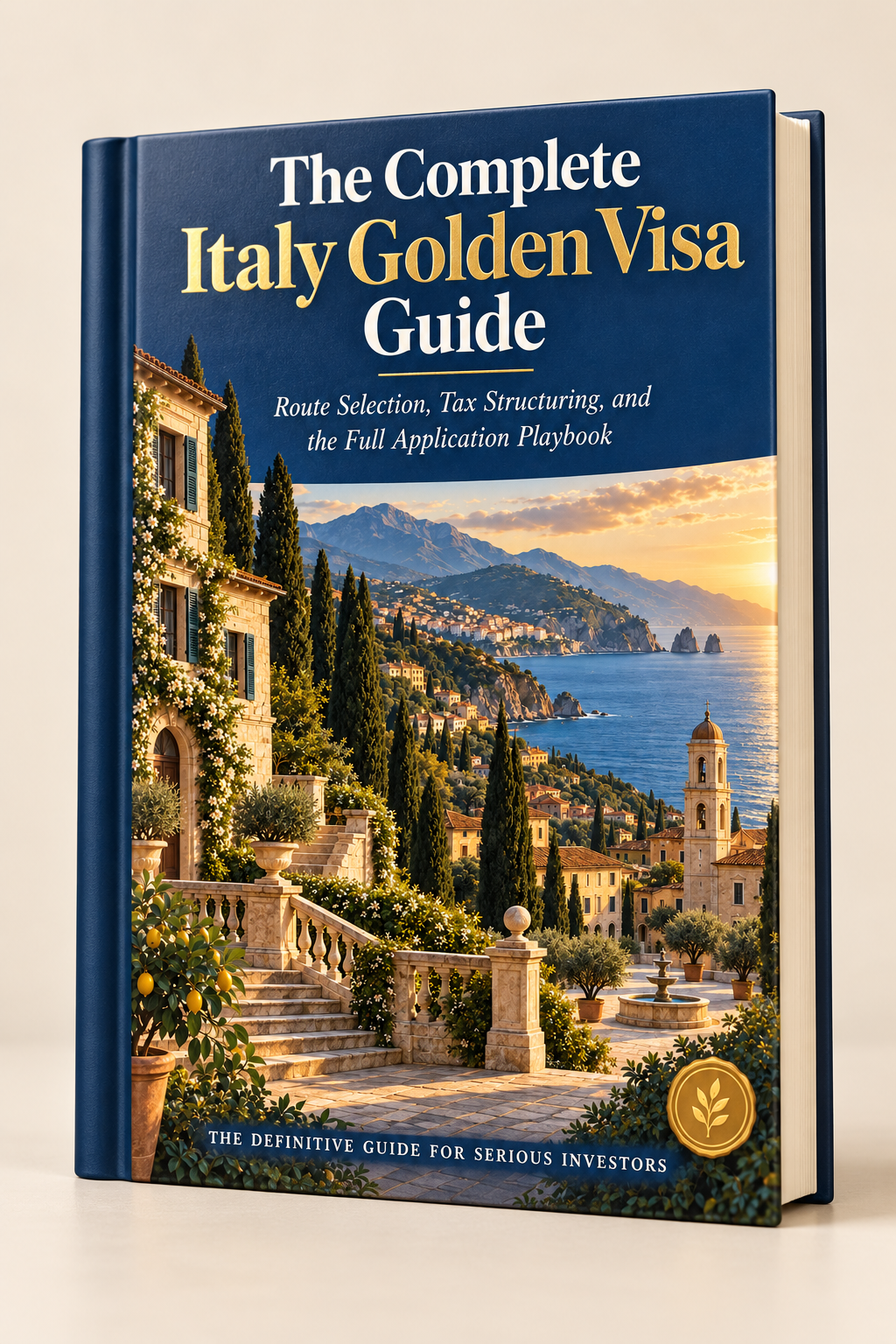
Know all the details:
This page covers the basics.
The complete guide goes deep on all four routes — worked case studies for US, UK, and Canadian investors, the exact application timeline, ready-to-use templates, and the tax details that actually decide which route fits you.
Everything you need to know to make the right choice.
Free updates for 2 years if the rules change.
48 pages, instant download.
How the Application Actually Works
This is the part most overviews skip past. Here's the real sequence:
1. Choose your route and prepare your file. Passport copy, a CV showing your professional background, bank statements proving the funds, a letter confirming the funds were legally acquired, a clean criminal record certificate, and proof of health insurance.
2. Apply for the Nulla Osta — before you invest a single euro. This is the part people most often get backwards: you register on Italy's official Investor Visa portal and apply for a "certificate of no impediment" before transferring any investment funds, not after. Your application goes to the Investor Visa Committee at Italy's Ministry of Enterprise and Made in Italy.
3. Wait for approval. The Nulla Osta typically takes 45 to 60 days. Once granted, it's valid for six months — that's your window to move to the next step.
4. Apply for the visa at your local consulate. With the Nulla Osta in hand, you submit your actual visa application to the Italian consulate with jurisdiction over you.
5. Enter Italy and make the investment. Once you enter on the visa, you have three months to actually complete the qualifying investment — this is the point where the money moves, not before.
6. Apply for your residence permit. At your local Questura, converting your visa into an actual Permesso di Soggiorno.
Total time, start to finish: typically 3 to 6 months, depending on how quickly your documents come together. There's no annual quota or seasonal application window — unlike many Italian visa categories, you can apply at any point during the year.
The visa itself: a 2-year residence permit, renewable in 3-year increments for as long as you maintain the investment.
What You Actually Get
No minimum stay requirement. You're not required to spend a set number of days per year in Italy to maintain your status — a real point of flexibility most Italian residency programs don't offer.
Full work rights. This is the biggest practical difference from the ERV, which strictly forbids any form of work. Golden Visa holders can be employed by an Italian company, freelance, or found and run their own business — a shop, a café, a short-term rental, a consultancy. No separate work permit needed.
Family included, with the same rights. A spouse, dependent children, and even dependent elderly parents can be included through a fast-tracked Family Visa process — with full residency and work rights of their own.
A real path forward. Permanent residency after 5 years. Citizenship eligibility after 10 years of continuous residency.
Golden Visa Holders and Retiring in Italy: A Connection Worth Knowing
If you're a retiree considering the Golden Visa specifically because you want to retire in Italy without dealing with the ERV's ban on all work, there's a tax nuance worth knowing: you may not be limited to Italy's flat €300,000-a-year tax regime for wealthy new residents.
If your income genuinely comes from pension or retirement sources, and you settle in a qualifying small town in Southern or Central Italy, you may be able to elect Italy's 7% flat-tax regime for foreign retirees instead — taxed as a straight 7% of your actual pension income, not a flat six-figure sum regardless of amount. For most retirees, that's a dramatically better outcome than the €300,000 regime, which exists for a very different kind of income profile.
These two programs are alternatives to each other, not something you stack together — worth discussing directly with a cross-border tax advisor to see which one actually fits your numbers.
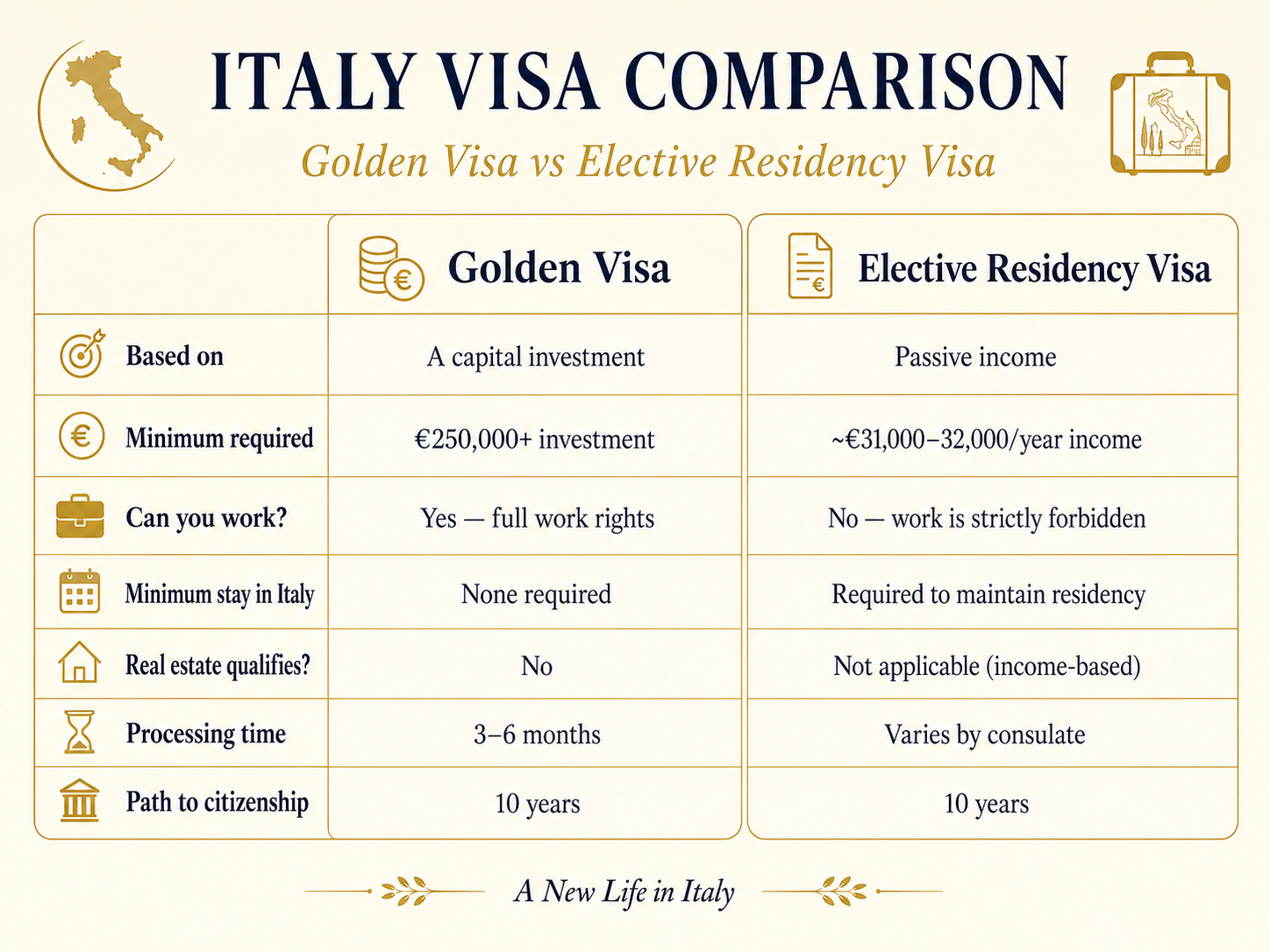
Golden Visa vs. Elective Residency Visa: The Real Comparison
Who This Is Actually For
This isn't the path for most people planning to retire in Italy. If you're living on Social Security, a pension, or investment income — not making a six or seven-figure capital investment — the Elective Residency Visa is almost certainly the right program, not this one.
The Golden Visa makes sense specifically if:
st, separate from your living expenses
You want the ability to actively work or run a
You have €250,000 or more available to inve business once you move to Italy
You don't want to be tied to a minimum number of days per year in the country
Who This Isn't For
If none of the above applies to you, don't worry — you're the majority of people watching this content, not the exception. The Italy Retirement Blueprint walks through the ERV path most people actually use to retire in Italy.
Frequently Asked Questions
-
No. Unlike Portugal's or Greece's programs, real estate does not qualify under any of Italy's four investment tiers.
-
No — this is a common misconception. You apply for the Nulla Osta first, and only make the actual investment after you've entered Italy on the visa, within a three-month window.
-
Yes. Spouses, dependent children, and dependent elderly parents can be included through a fast-tracked Family Visa process, with the same residency and work rights.
-
The core difference is work rights and stay requirements. The ERV requires no investment but forbids any work and typically expects you to actually live in Italy. The Golden Visa requires real capital but allows full work rights and has no minimum-stay requirement.
-
Typically 3 to 6 months from application to residence permit, assuming documents come together without delays.