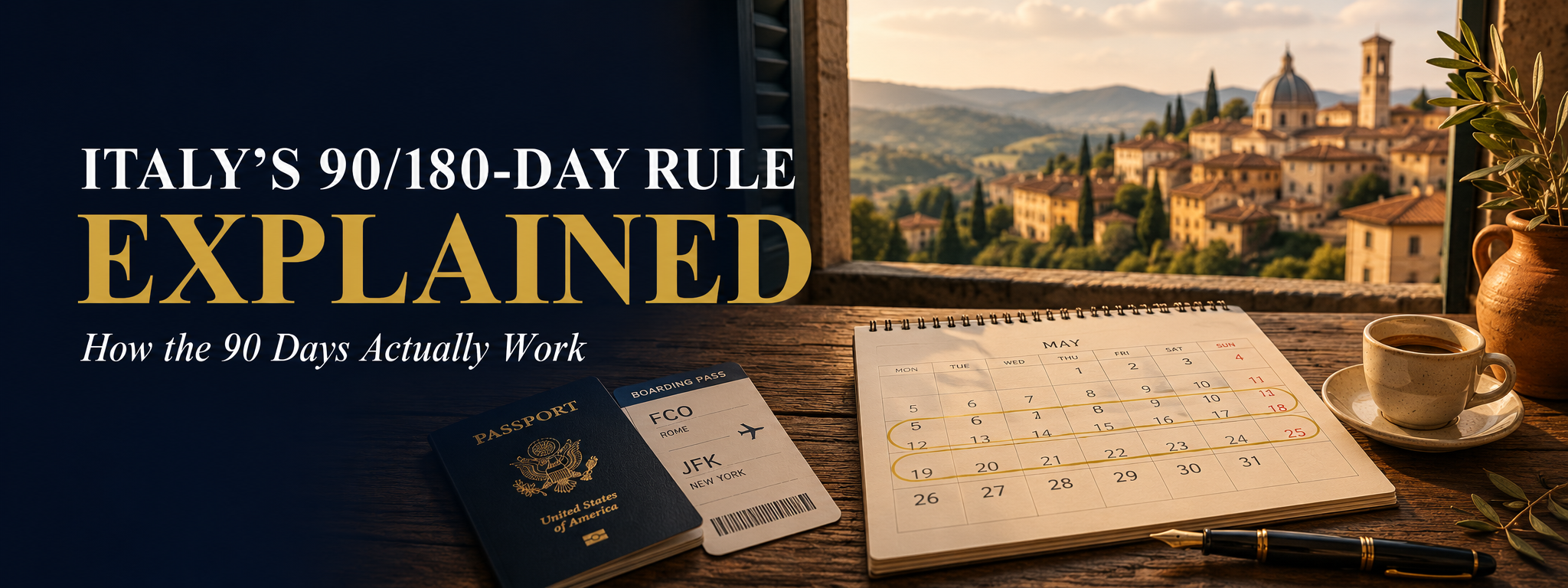
Italy’s 90/180-Day Rule Explained
The rule sounds simple:
You can spend up to 90 days in Italy without a long-stay visa.
But that sentence leaves out the part that causes nearly all the confusion.
The 90 days are not calculated separately for Italy. They apply across the entire Schengen Area, and they must fit inside a constantly moving 180-day window.
Leaving Italy does not automatically reset your allowance.
Spending a weekend outside Europe does not give you another 90 days.
And staying for three months, leaving for three months and returning can work—but only when the exact calendar dates support it.
This guide explains how the rule actually works, how to calculate your available days and how to avoid an accidental overstay.
This article is written primarily for visa-exempt non-EU visitors, including many travelers from the United States, Canada, the United Kingdom and Australia. EU, EEA and Swiss citizens have different freedom-of-movement rights. Travelers holding a long-stay visa or residence permit are also governed by different rules.
Planning a part-time Italian life?
The 90/180-day rule can allow you to build a meaningful part-time life in Italy while keeping your home and legal residence elsewhere.
Read the Complete Guide to Living in Italy Part-Time
The quick answer
For a short stay, you may generally spend:
90 days inside the Schengen Area during any rolling 180-day period
Every day you are physically inside the Schengen Area counts as one day.
Your date of entry counts as your first day.
Your date of exit counts as your final day.
On each day of your trip, you must be able to look back over that day and the preceding 179 days and find no more than 90 Schengen days in total.
That is why the rule is commonly described as:
90 days in any 180 days
The important word is any.
Prefer to see the calculation for your own travel dates? Use the free tool below.
It is one allowance across the Schengen Area
You do not receive 90 days in Italy, another 90 days in France and another 90 days in Spain.
The allowance is shared.
For example:
40 days in Italy
20 days in France
10 days in Spain
That equals 70 Schengen days.
You would normally have 20 days left within the relevant rolling window—not another 90 days when you cross back into Italy.
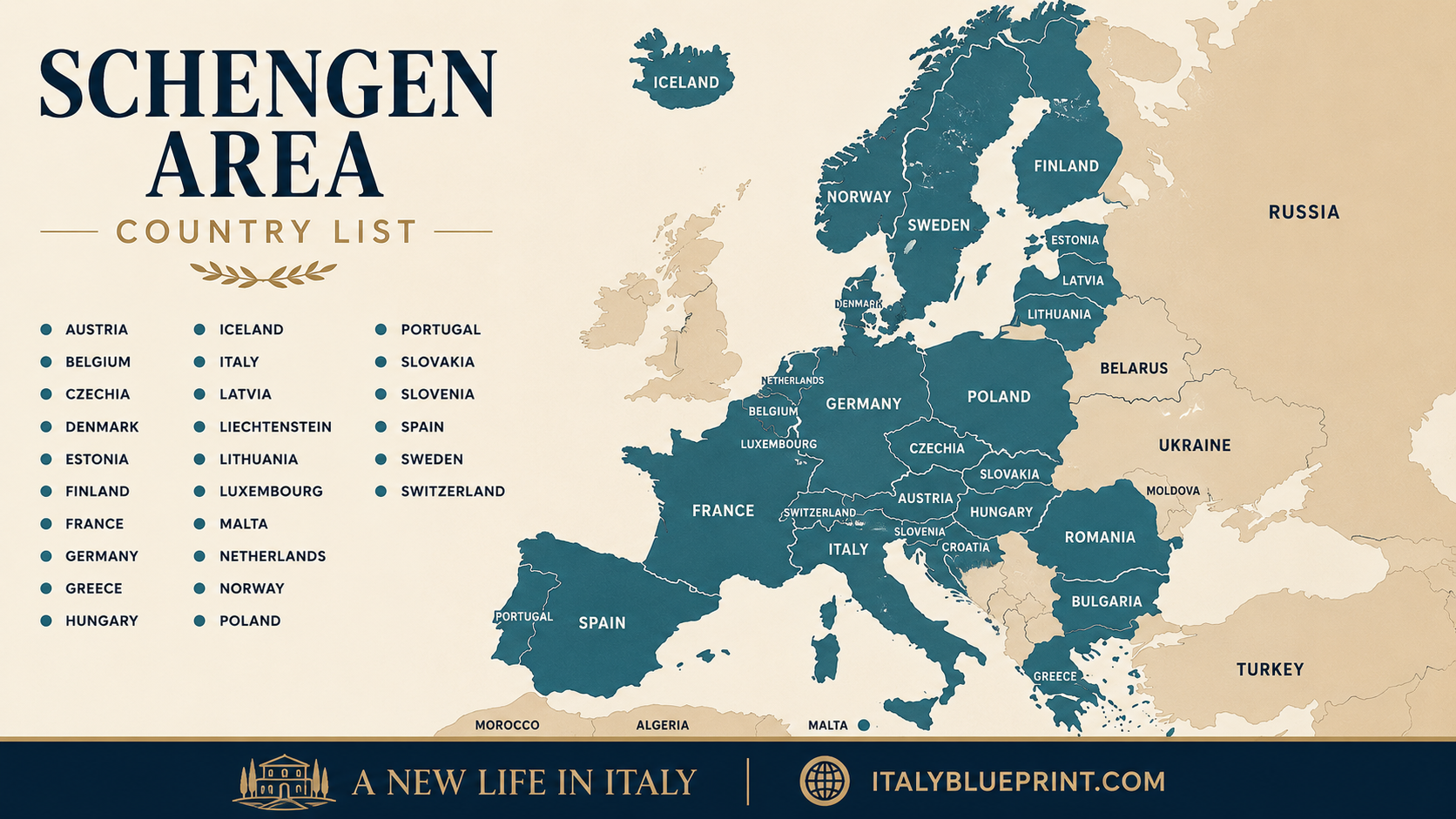
The Schengen Area currently includes 29 countries, including Italy, France, Spain, Germany, Greece, Portugal, Switzerland, Norway, Bulgaria and Romania. Cyprus and Ireland are not part of the Schengen Area.
Travel within Schengen usually does not create a new external-border entry or exit. Flying from Italy to France therefore does not stop your Schengen clock.
What does “rolling 180 days” mean?
The 180-day period is not a fixed block beginning with your first trip.
There is no universal January-to-June period followed by a fresh July-to-December period.
Instead, the window moves forward one day at a time.
Imagine standing on any particular date during your stay and looking backwards over the previous 180 calendar days.
Count every day you were inside the Schengen Area during that window.
If the total is 90 or fewer, you comply with the general short-stay limit.
If the total reaches 91, you have potentially overstayed.
The European Commission describes this as counting backwards 180 days from every day of the stay and making sure the total does not exceed 90.
Think of it as a moving window
The easiest mental picture is a window containing 180 calendar days.
Every morning:
One new day enters the front of the window.
One old day drops out of the back.
Your remaining allowance may change.
Your previous days do not all disappear at once. They usually become available again one by one as they move outside the 180-day lookback period.
Example 1: One continuous 90-day stay
Imagine you enter Italy on:
January 1, 2026
and leave on:
March 31, 2026
That is exactly 90 calendar days:
January: 31 days
February: 28 days
March: 31 days
You have used your full short-stay allowance.
You cannot leave on April 1 and return two weeks later for another long stay.
Most or all of those original 90 days would still sit inside the relevant rolling 180-day window.
If you remain completely outside the Schengen Area, the first January days begin ageing out of the window near the end of June. In this example, June 30, 2026 is the first possible date on which a new continuous stay can begin as old days gradually drop out.
A full 90 consecutive days outside the Schengen Area generally allows the earlier short-stay days to age out, making a new stay of up to 90 days possible.
Do not rely on that sentence alone when booking flights. Enter your precise dates into a calculator.
Example 2: Splitting the 90 days
The 90 days do not have to be used in one continuous block.
You could make several visits.
For example:
20 days in Italy in spring
25 days in France during summer
15 days in Italy in autumn
That gives you 60 Schengen days, provided all 60 fall inside the same relevant 180-day lookback window.
You may then have as many as 30 days remaining.
But you cannot determine the answer simply by adding the trips forever. Older days eventually leave the window, and newer trips may fall into a different calculation period.
That is why someone may have:
10 days available today
11 days available tomorrow
25 days available several weeks later
The allowance can recover gradually.
Example 3: Why leaving does not reset the clock
Imagine you spend 90 days in Italy and then fly to the United Kingdom for ten days.
The United Kingdom is outside the Schengen Area, so those ten days do not use additional Schengen days.
But the trip does not erase your previous Italian stay.
When you try to return, the border calculation still looks backwards across the previous 180 days. Most of your original 90 days remain visible.
You have stopped adding new Schengen days while outside, but you have not reset the system.
This distinction matters:
Leaving stops the count. Time outside allows old days to age out. Leaving does not instantly restore 90 days.
Entry and exit days both count
A common mistake is to count nights rather than calendar days.
Schengen calculations use days.
If you enter Italy late on Monday evening, Monday counts.
If you leave early on Friday morning, Friday also counts.
A Monday-to-Friday visit therefore uses five Schengen days, even if you slept in Italy for only four nights. EU guidance treats the entry date as the first day and the exit date as the final day of the stay.
This becomes important when someone repeatedly takes short trips and assumes the arrival or departure days do not matter.
Midnight connections can affect the calculation
Suppose you fly from Rome to New York but connect through Paris.
You normally leave the Schengen Area when you pass through external border control in Paris—not when your aircraft leaves Rome.
Similarly, when arriving through Frankfurt before continuing to Italy, you ordinarily enter Schengen in Germany.
Your travel record should reflect the external Schengen entry and exit points, not merely the Italian airports on your itinerary.
For complicated itineraries, retain:
Boarding passes
Flight confirmations
Hotel records
Ferry or train tickets
Any available border documentation
The EES now records entry and exit details electronically for covered non-EU short-stay travelers, but keeping your own travel history remains sensible.
What changed with the EES?
The Entry/Exit System, or EES, is now fully operational across the participating Schengen countries.
It electronically records covered non-EU short-stay travellers when they cross external borders. The recorded information can include passport details, dates and locations of entry and exit, a facial image and fingerprints.
The EES became fully operational on 10 April 2026, replacing routine passport stamping for covered travellers throughout most of the participating countries.
The EES does not give you additional days.
It does not replace the 90/180 rule.
It makes entry, exit and possible overstay records more systematic.
This means the strategy of hoping a border officer will overlook an incorrectly counted trip is increasingly unrealistic.
Is EES the same as ETIAS?
No.
They are separate systems.
EES records border crossings and travel data for covered non-EU short-stay travellers. You do not submit a standard EES application before travelling.
ETIAS will be a pre-travel authorisation requirement for many visa-exempt travellers. It is scheduled to begin in the last quarter of 2026, but the European Union had not announced its exact starting date at the time this page was prepared.
ETIAS will not create a longer stay allowance.
An ETIAS authorisation does not mean you can remain in Italy for more than 90 days in the relevant 180-day period.
Use only the official EU application channel once ETIAS opens. Fraudulent and unofficial websites may imitate the application process or charge unnecessary fees.
Does owning a home in Italy give you more days?
No.
Buying an Italian property does not, by itself, give a non-EU visitor the right to remain in Italy beyond the normal immigration allowance.
The property may give you somewhere to stay, but it does not replace:
A visa
A residence permit
Citizenship
Freedom-of-movement rights
This is one reason I repeatedly recommend renting or testing an area before committing a large amount of money to an Italian property.
You could own a house in Italy and still be unable to use it throughout the entire year under visitor status.
Common 90/180-day mistakes
Mistake 1: Counting only Italy
Days in other Schengen countries normally use the same allowance.
Mistake 2: Believing departure creates a fresh 90 days
Departure stops new days accumulating. It does not erase the days already used.
Mistake 3: Counting nights instead of days
Arrival and departure dates both count.
Mistake 4: Assuming the calendar year matters
January 1 does not automatically restore your allowance.
Mistake 5: Forgetting an older European trip
A short visit to Spain or France months earlier may still fall within your current 180-day window.
Mistake 6: Using every last day
Flight cancellations, illness, strikes and travel disruptions can turn a perfectly calculated stay into an overstay.
Mistake 7: Treating an online calculation as a legal guarantee
The European Commission describes its calculator as a helping tool. The competent authorities ultimately apply the rules and determine whether a stay is authorised.
Leave a safety buffer
Technically using all 90 available days may appear efficient.
Practically, it leaves no room for anything to go wrong.
Consider leaving several unused days, especially when:
Your flight itinerary is complicated
You are travelling during winter
You have health concerns
You rely on connecting flights
Your calculation contains numerous previous trips
Your passport or travel records contain inconsistencies
Five unused days can be far more valuable than five additional days in Italy when an unexpected problem occurs.
A buffer is not legally required. It is sensible planning.
How to track your days correctly
Maintain one master travel record.
For every Schengen trip, record:
Entry date
Exit date
Entry country
Exit country
Total calendar days
Flight or booking reference
Do not track Italy separately from France, Spain, Greece or other Schengen destinations.
Before booking a new trip:
Enter all relevant previous stays.
Test your proposed arrival date.
Test your proposed departure date.
Leave a buffer.
Recheck the calculation immediately before travelling.
The European Commission’s calculator offers both a check mode for past or current compliance and a planning mode for testing a proposed future entry date.
Can you genuinely live in Italy using this strategy?
You cannot use short-stay visitor status to live permanently in Italy while pretending to be a tourist.
But you can use the permitted time to create a genuine part-time life.
You can:
Return to the same town
Rent for several weeks or months
Build local routines
Learn the language
Experience Italy outside the holiday season
Test different regions
Keep your home and commitments elsewhere
Decide whether permanent relocation is right for you
The goal is not to trick the system.
The goal is to use the legal flexibility it already provides.
Read How to Live in Italy Without Moving to Italy for the complete practical strategy, including housing, healthcare, transportation, banking and maintaining a home base elsewhere.
When you need a different immigration path
The 90/180 strategy is not enough when you want to:
Remain in Italy throughout the year
Establish permanent legal residence
Work under circumstances requiring authorisation
Enrol fully in resident services
Build your main family life in Italy
Stay beyond the short-stay limit
At that stage, you may need an appropriate Italian long-stay visa, residence route or citizenship-based right.
The 90-day strategy is not a replacement for residency.
It is a way to experience more of Italy before making that commitment—or to maintain a flexible part-time life when permanent relocation is not the right choice.
A practical part-time schedule
A repeatable plan could look like this:
Autumn
Spend September through November in Italy.
Winter holidays
Return home for family, Christmas and existing commitments.
Early year
As previous Schengen days gradually move outside the 180-day window, plan another stay based on the exact number of days available.
The precise return date will depend on your earlier entry and exit dates. Never copy someone else’s schedule without recalculating it for yourself.
Your plan must reflect your travel history—not a general rule of thumb.
Final thoughts
The 90/180-day rule is not complicated because of the number 90.
It is complicated because the 180-day window keeps moving.
Once you understand that, the strategy becomes much clearer:
All Schengen countries share the allowance.
Entry and exit days count.
Leaving does not instantly reset anything.
Old days return gradually.
Your exact travel history controls the answer.
EES now records covered border crossings electronically.
ETIAS will not give you additional time.
The rule can feel restrictive when misunderstood.
Used carefully, it can also create something valuable: the ability to spend meaningful stretches of every year in Italy without making an immediate permanent move.
That may be enough to test the dream.
For some people, it may become the ideal life.